Throughout this site there are links to documents of various file types. Please contact our Statewide Program Leader if you require this information in a different format.
Protecting water resources through sustainable gardening
Engaging university-trained volunteers to empower and sustain diverse communities with relevant, unbiased, research-based horticulture and environmental stewardship education. Read about Extension Master Gardeners in the news around Washington state.

Public Value
The WSU Extension Master Gardener Program directly improves public health and environmental sustainability by educating communities on clean water practices that safeguard local ecosystems. Through science-based outreach and hands-on demonstrations, volunteers empower individuals to reduce harmful chemicals, enhance water quality, and protect vital waterways. Their efforts seek to lower municipal costs for water treatment and healthcare while fostering environmental stewardship and a deeper connection to local water systems. By promoting sustainable water management, Master Gardeners help ensure clean, accessible water for future generations.
Issue
Clean water is essential for human health, thriving communities, and economic stability. Protecting upstream water sources is critical to safeguarding downstream communities that rely on them. Approximately 117 million Americans, or one in three people, depend on drinking water from streams previously at risk of pollution before the Clean Water Rule. Gardening and landscaping practices play a significant role in water quality—excess pesticides and fertilizers can seep into surface and groundwater, threatening this precious resource.
Consequences
Neglecting clean water upstream has widespread impacts. Contaminated water endangers public health, leading to infectious diseases, chemical exposure, and developmental challenges. Ecosystems suffer as pollutants disrupt aquatic habitats, harm wildlife, and decrease biodiversity. Economically, the burden of pollution includes high water treatment costs and losses in industries like fishing, agriculture, and tourism. Communities dependent on polluted sources face water scarcity, reduced quality of life, and increased healthcare expenses. Persistent pollution causes lasting harm to ecosystems, compromising biodiversity and environmental resilience. Implementing responsible gardening and landscaping practices is vital to protecting water resources for current and future generations.
Outreach
WSU Extension Master Gardener Program volunteers play a pivotal role in promoting clean water and environmental health through education on integrated pest management (IPM) practices. Their efforts focus on preventing harmful chemicals from polluting water systems and reducing soil erosion and runoff. Key achievements include:
- Addressed 3,650 public inquiries on the least toxic pest control methods at Ask a Master Gardener plant and insect clinics.
- Delivered 379 classes for adults and 10 for youth, focusing on pesticide safety, proper use, and IPM principles.
- Organized 40 demonstrations showcasing IPM techniques for effective pest management.
- Facilitated 22 hands-on workshops where participants practiced IPM methods in landscape pest control.
- Hosted 308 field days, providing an immersive learning experience on implementing IPM practices in real-world settings.
- Educated 2,686 adults and 541 youth on the importance of clean water and how gardening decisions impact water quality.
- Taught participants how to properly apply fertilizers, identify pests and diseases, reduce or avoid chemical use, and prevent soil erosion.
Through these initiatives, Extension Master Gardeners empower communities to adopt sustainable gardening practices that protect vital water resources.
Reported Impacts
Of those surveyed:
- 20% gained a deeper understanding of how clean water directly IMPACTS human health, local wildlife, and natural ecosystems.
- 17% increased understanding of how human activity intensifies THREATS to water resources.
- 7% participants gained a clearer understanding of their personal RESPONSIBILITY in preventing pollutants from entering waterways.
- 27% gained a deeper understanding of gardening TECHNIQUES that enhance water quality.
- 73% COMMITTED to practicing Integrated Pest Management (IPM) and employing sustainable gardening techniques to minimize chemical inputs.
Doing our part
In a collaborative effort, four committed WSU Extension Jefferson County Master Gardener Program volunteers conducted a native plant salvage operation at a Habitat for Humanity home site prior to construction. Their work successfully preserved over 40 sword ferns, 20 star flowers, as well as several red flowering currants, snowberries, elderberries, and serviceberries. These rescued plants were relocated to a newly created rain garden at the Northwest School of Wooden Boat Building in Port Hadlock.
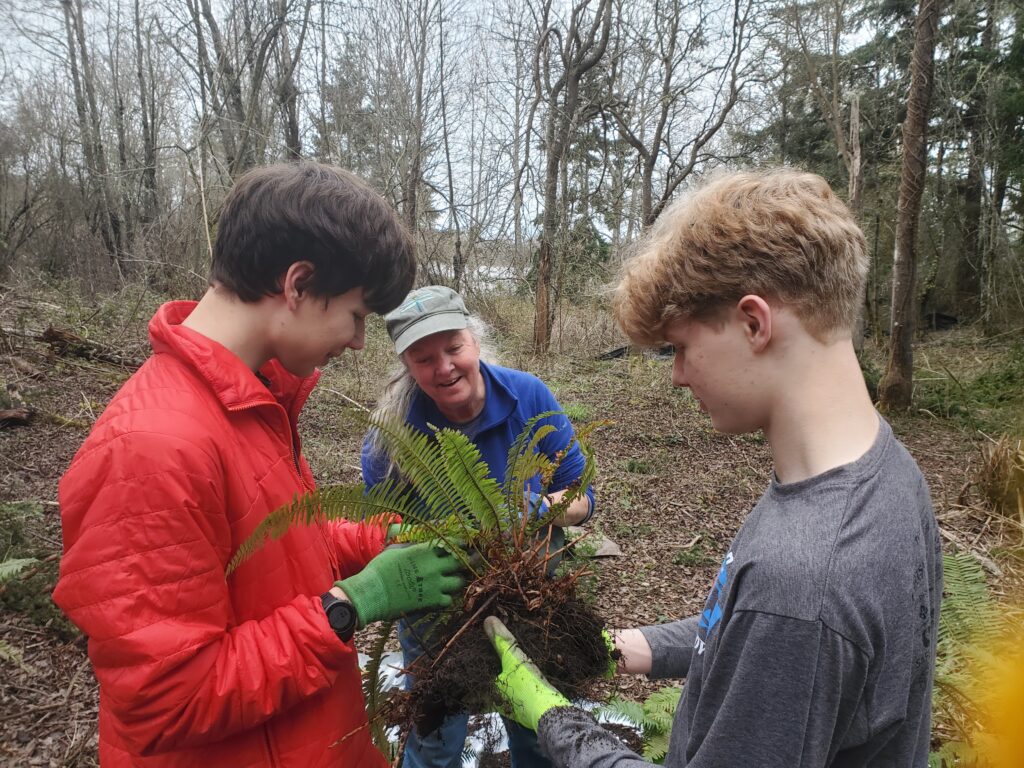
This rain garden serves a vital ecological purpose, capturing water runoff from the nearby road and protecting Port Hadlock Bay, situated just below the school. By filtering and intercepting runoff, it helps prevent pollutants from reaching the bay, ensuring cleaner water and supporting a healthier marine environment.
WSU Extension Snohomish County Master Gardener Program is dedicated to reducing water pollution from home landscapes by educating the public on minimizing rainwater runoff into storm drains. In collaboration with Snohomish County Stormwater Management, they offered a 5-day Rain Scaping class to Extension Master Gardener volunteers in 2024.
During the course, participants learned to evaluate rainwater issues based on client self-reports and recommend solutions aligned with Snohomish County Stormwater Management guidelines. The training emphasized the importance of preventing rainwater runoff and encouraging water to soak into the soil to protect water quality and reduce pollutants.
Following the class, 90% of participants reported feeling confident in their ability to effectively share their knowledge and educate the public on these essential practices.
WSU Extension Spokane County Master Gardener Program volunteers educated 747 residents through events focused on sustainable landscaping practices, emphasizing ways to minimize the overuse of fertilizers and pesticides. The program also hosted 211 diagnostic clinics, assisting 598 residents with questions about proper fertilizer application and the management of plant pests and disorders. Additionally, 152 residents accessed locally developed fact sheets on topics such as erosion control, plant care, and pesticide-free pest management alternatives.
Post-education surveys in Spokane County highlighted significant knowledge gains among participants:
- A 28% increase in understanding the importance of soil nutrient testing before applying fertilizers.
- A 29% improvement in knowledge on reducing pesticide use on turf grass.
- A 35% increase in awareness of the importance of proper diagnosis before using pesticides.
- A 44% increase in familiarity with WSU resources for informed pest management decisions.
These efforts have empowered community members with the tools and knowledge to adopt environmentally sustainable gardening practices.