Funding for a sustainable future
Support the Master Gardener ProgramThroughout this site there are links to documents of various file types. Please contact our Statewide Program Leader if you require this information in a different format.
Progress in action: supporting lasting impacts
Public Value:
In 2024, the WSU Extension Master Gardener Program saw 3,649 volunteers collectively contribute an impressive 318,134 hours of service, valued at $11,093,333 according to the Independent Sector. These efforts are equivalent to 154 full-time positions, demonstrating the extraordinary dedication of volunteers in fostering plants, people, and communities to build a resilient Washington.
About Program funding
As a Land Grant University, Washington State University (WSU) has responsibilities to teach, research, and extend knowledge to all people. The Extension Master Gardener Program, launched in 1973 by WSU, is one way that land-grant universities fulfill those purposes. The success of the WSU Extension Master Gardener Program has led to the replication of the program across the United States and internationally with over 100,000 master gardeners serving their communities.
The WSU Extension Master Gardener Program is funded through the USDA NIFA | National Institute of Food and Agriculture, Washington State University | Washington State University, county governments, grants, fees for service, donor gifts and bequests, and by the generosity of Master Gardener Foundations.
The following chart depicts the direct support that comes from WSU through USDA-NIFA, County governments, and WSU to pay for the salaries and benefits of the faculty and staff who provide direct support to the WSU Extension Master Gardener program. Through 13 full time equivalent positions, 11 half-time positions, and 41 partial appointments, goods and services, travel, and administrative services, WSU provides over $2 million annually to our Program.
This amount does not include ancillary programs like support from WSU’s College of Agricultural, Human, and Natural Resource Sciences (CAHNRS) IT and CAHNRS Marketing and Communications. It does not include the direct support our program receives from the Pesticide Resource and Education Program (PREP) or from the WSU Integrated Pest Management Team, which share the responsibility for Hortsense, Pestsense, Pesticide Information Center Online (PICOL) and for delivering pesticide use and safety education to extension master gardener volunteers. Nor does it include direct support from the Academic Office of Innovation (AOI), which supports the delivery of basic training.
Also excluded from this amount is the value of facilities, maintenance, and operations provided by WSU. Our Program benefits from the office space, computer equipment and the supplies within. It benefits from the use of land for demonstration gardens on Research and Extension Center properties and from the use of facilities such as sheds, greenhouses, and teaching spaces.
The chart also shows the financial support provided by the Master Gardener Foundations. The amount reflects the sum of 18 out of 22 foundation’s operating budgets less grants or gifts that are offered outside of the Extension Master Gardener Program. Funds from Foundations are used to support the delivery of educational outreach and volunteer recognition events and awards, and general operations of the WSU Extension Master Gardener Program.
Financial support for the WSU Extension Master Gardener Program (estimated)
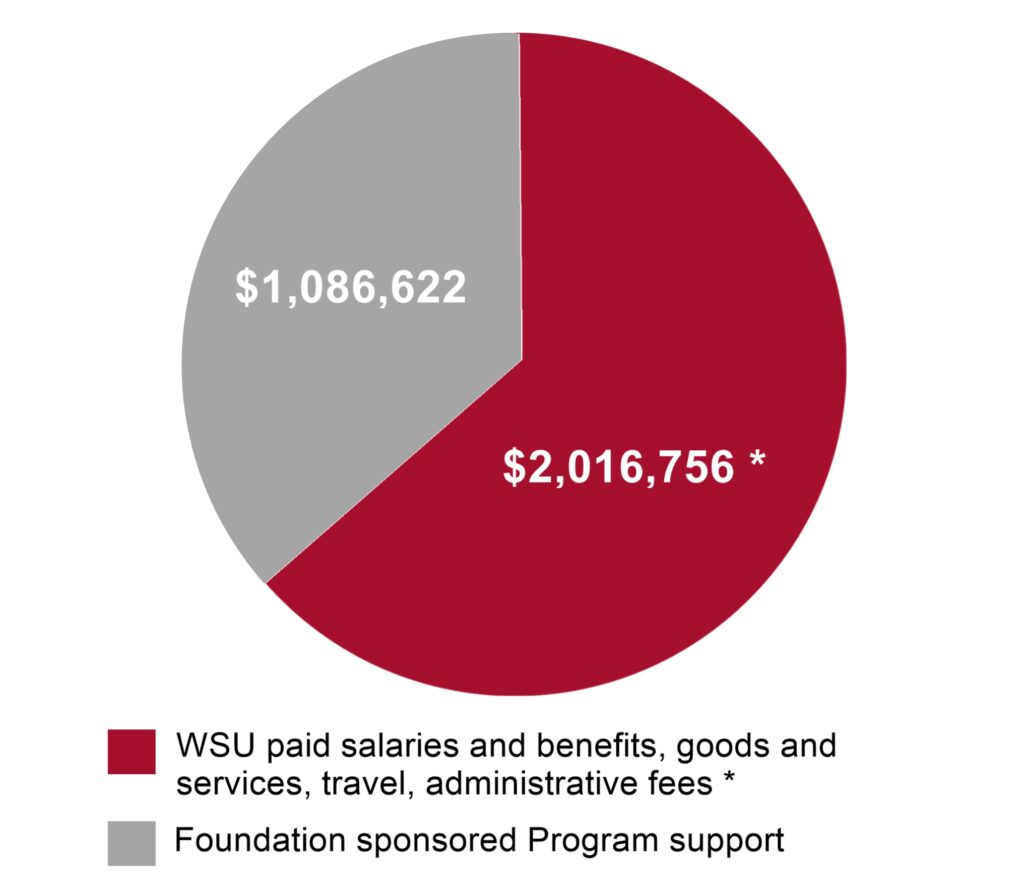
*This amount excludes support from various WSU programs, facilities, and resources, including CAHNRS IT, CAHNRS Marketing, PREP, the Integrated Pest Management Team, AOI, and the value of office space, equipment, and land for demonstration gardens.